|
1
|
- Keith Alcock
- TCS DevSIG
- 6 April 2004
|
|
2
|
- Theory
- Implementation
- Example from book
- Extension of example
- My projects
- Discussion
|
|
3
|
- Source
- Code Generation in Action
Jack Herrington
Manning Press, 2003
- www.manning.com/herrington
(Table of Contents, Chapter 1, Chapter 4)
www.codegenerationinaction.com
www.codegeneration.net
- Definition
- The technique of building and using programs to write other programs.
- Passive generators maintain no responsibility for the code…like many
“wizards” in IDEs.
- Active generators maintain responsibility by allowing the generator to
be run multiple times over the same output.
|
|
4
|
- Implementation technique
- Design pattern
- Regular expression escaping
- Development process
- Extreme programming
- Automatic generation of unit tests
- WordNet preprocessor
- Language type
- Object orientation
- Rules of Dutch morphology for PUMA
|
|
5
|
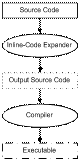
- Code munging
- Inline-code expansion
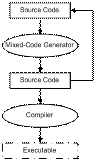
- Mixed-code generation
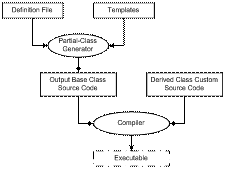
- Partial-class generation
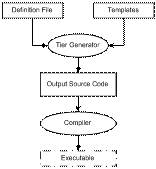
- Tier or layer generation
- Domain language
|
|
6
|
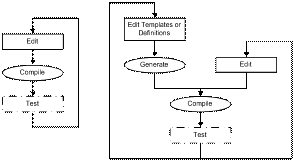
- Description
- Pick out important features of some input code and use them to create
one or more output files.
- Examples
- Create documentation
- Catalog strings for internationalization
- Report on resource identifier usage
- Analyze code and report compliance with company standards
- Create indices of classes, methods, or functions
- Find and catalog global variable declarations
|
|
7
|
|
|
8
|
- Description
- Take source code containing special markup and create production code
as output.
- Examples
- Embedding SQL in implementation files
- Embedding performance-critical assembler sections
- Embedding mathematical equations, which are then implemented by the
generator
|
|
9
|
|
|
10
|
- Description
- Read a source code file, modify it based on formatted comments, for
example, and replace the file.
- Examples
- Building rudimentary get/set methods (accessors)
- Building marshalling code for user interfaces or dialog boxes
- Building redundant infrastructure code, such as C++ copy constructors
or operator= methods
- Converting from model (data) to presentation (controls)
- Generating unit tests
- Escaping regular expressions
- Pre-compiling and obfuscating regular expressions
|
|
11
|
|
|
12
|
- Description
- Read an abstract definition file and use templates to build base class
libraries.
- Examples
- Building data access classes that you can override to add business
logic
- Developing basic data marshalling for user interfaces
- Creating RPC layers that can be overridden to alter behavior
|
|
13
|
|
|
14
|
- Description
- Build a complete tier of an n-tier system using, for example,
model-driven generation from a UML diagram.
- Examples
- The RPC layer of an application that exports a web services interface
- The stub code in a variety of different languages for your RPC layer
- The dialog boxes for a desktop application
- The stored procedure layer for managing access to your database schema
- Data export, import, or conversion layers
|
|
15
|
|
|
16
|
- Description
- Develop a language to describe the domain and convert it into
executable code.
- Examples
- Mathematica
- PUMA language
|
|
17
|
|
|
18
|
- N-Tier development
- User interfaces
- Business logic
- Database access
- Interfacing
- Remote procedure access
- Web services
- DLL wrapper
- External language wrapper
- Data management
- File formats
- Firewall configuration
- Lookup tables and functions
- Documentation
- Unit tests
|
|
19
|
- Engineers
- Quality
- Consistency
- Single point of knowledge
- More design time
- Design decisions that stand out
- Managers
- Architectural consistency
- Abstraction
- High morale
- Agile development
- Code
- Portability
- Documentation
- Performance
- Obfuscation
|
|
20
|
- Give the proper respect to hand-coding.
- Handwrite the code first.
- Control the source code.
- Make a considered decision about the implementation language.
- Integrate the generator into the development process.
- Include warnings.
- Make it friendly.
- Include documentation.
- Keep in mind that generation is a cultural issue.
- Maintain the generator.
|
|
21
|
- Programmer
- Using text templates
- Writing regular expressions
- Tools
- Parsing XML
- File and directory handling
- Command-line handling
|
|
22
|
- Ruby
- Language similar to Perl or Python
- Also mentions C, C++, C#, Java, SQL
- Rexml
- XML parser library as are XMLParser, ruby-libxml
- Also mentions SAX, DOM
- ERb
- Tool for templates as is ERuby
- Also HTML::Mason, JSP, ASP, PHP
- Regular expressions
- pcre.h (Perl compatible regular expressions for C)
- Version control
- Perforce with Perl binding
- Command line
- Others
- C pre-processor, M4 macros
|
|
23
|
- Example
- Mixed-code generator
- printf.rb generates printf statements for C code
- Could translate, escape, encrypt, hash, etc.
- Extension
- quote.rb looks for REs and escapes them
- Apply it to printfquote.rb to generate equivalent of printf.rb
- Apply printfquote.rb to C code
|
|
24
|
- Is a code-munger
- Reverse engineers isa() functions from C
- Extends the pattern to user defined attributes
- Achieves code reuse without runtime overhead
- Assures cross-platform compatibility
|
|
25
|
- Is a code-munger, but could be converted to inline-code expander
- Converts regex strings into static C data structures using (manual)
reflection
- Improves performance with pre-compilation
- Involves no dynamic memory allocation
- Obfuscates strings from spies
- Obviates need to ship compiler component
|
|
26
|
- Is also a code-munger
- Converts database to static C data structures
- Drastically improves performance
- Reduces disk access to zero and memory allocation to minimum
- Combines string pointers
- Collects separate files into one
- Compresses the data structures
|
|
27
|
- NESU – Nijmegen Experiment SetUp
- Graphical programming environment for experiment generation with
round-trip capability within Smalltalk
- Configuration stored in Excel and converted to Smalltalk with VBA
program
- Document to XML converter
- Background vs. foreground text calculations
- SVG project
- RTF formatting
- Class definition generator for Smalltalk
- RTF source code listing for Smalltalk
- JavaScript generation of HTML on page load
- ASP.NET programming
|
|
28
|
- Who is using it and what for?
- Where else is generation prevalent?
- Refactoring, generation of accessors
- ASP, PHP, etc.
- XML
- What else could it do?
- Convert from math notation to programming language
|
|
29
|
- Code generation has a dramatic impact on development time and
engineering productivity.
- The application is amenable to change on a large scale.
- The business rules are abstracted into files that are free of language
or framework details that would hinder portability.
- The code for the application is of consistently high quality across the
code base.
- This is a powerful tool you should have in your bag.
|

 Notes
Notes